
Europa Blinds supplies and fits cellular (honeycomb) and pleated blinds across Bristol, for conservatories, bi-fold doors, roof panels, and shaped windows. Cellular blinds trap air at the glass, which cuts heat loss in winter and overheating in summer.
Thermal cellular and pleated blinds
Most window blinds are designed to look good or to control light. Cellular and pleated blinds do both of those things – but they also do something most other blinds don’t: they actively reduce heat transfer through the glass. In a Bristol home where the heating bill arrives every month and the conservatory is either too cold in December or too hot in July, that performance difference is tangible and worth understanding.
Both blind types fold down into a compact stack at the top or bottom of the window when not in use, making them one of the neatest solutions available for doors, angled skylights, conservatory roofs, and other window configurations where a conventional roller or Venetian won’t fit, won’t hang correctly, or would look clunky. The slim collapsed profile is particularly useful on bi-fold and French doors where any protrusion from the glass line gets in the way of the opening mechanism.
Pleated and cellular blinds are closely related – both use a fan-folded fabric construction – but they’re not the same product, and which one you need depends on where the blind is going and what you’re asking of it. The comparison below explains the difference.
The key structural difference is in the fabric cross-section. A pleated blind uses a single layer of fabric folded into tight accordion pleats. A cellular (or honeycomb) blind uses a double or triple layer of fabric bonded together to form enclosed air pockets – the honeycomb cells that give the blind its thermal properties.
Single layer, accordion pleated
Double or triple layer – enclosed honeycomb cells
Good – slim profile reduces draughts
Excellent – trapped air cells act as an insulating barrier
Very slim – 20-25mm typical
Slightly deeper than pleated due to cell depth
Doors, roof panels, standard windows
Conservatories, single glazing, poorly insulated frames
Wide – light filtering to blackout
Slightly narrower – focused on thermal performance fabrics
Generally lower
Higher – reflects the more complex construction
Doors and windows where slim stack is the priority
Thermal performance is the primary requirement
In practice, cellular blinds are the recommended choice when the window or space has a significant heat loss or heat gain problem – a single-glazed conservatory, an older property with original sash frames, or a south-facing glass extension. Pleated blinds are the right answer when the priority is a neat, slim fit on a door or roof panel where a conventional blind won’t work, and thermal performance is secondary.
The honeycomb cell structure of a cellular blind works on the same principle as a double-glazed unit – it traps a layer of still air between the fabric layers, and still air is an excellent insulator. Heat from the room that would otherwise conduct straight through the glass is slowed down by this air buffer, reducing the rate at which the room loses warmth in winter.
The same principle works in reverse in summer. Solar energy arriving through the glass encounters the air-filled cells before it reaches the room. The cells absorb some of the heat and slow its transfer inward, reducing the rate at which a conservatory or south-facing room heats up during the day.
How significant is the thermal benefit?
Independent testing of cellular honeycomb blinds shows a reduction in heat loss through a standard window of between 30% and 46% compared with an unblinded window, depending on the cell depth and fabric. In a single-glazed conservatory – which is essentially a glass box – this is a meaningful real-world difference to winter comfort and heating costs. For a room that’s currently unusable in cold weather, it can extend the usable season by several months.
For Bristol homeowners who’ve been managing rising energy costs, cellular blinds on a conservatory or on older, single-glazed windows are one of the more cost-effective upgrades available. The payback period is real – not a marketing claim.
Every quote starts with a free home visit. We bring the samples to you and measure every window, at no charge.
These blind types solve specific architectural problems that other products handle poorly. Here are the most common applications we see across Bristol and the South West.
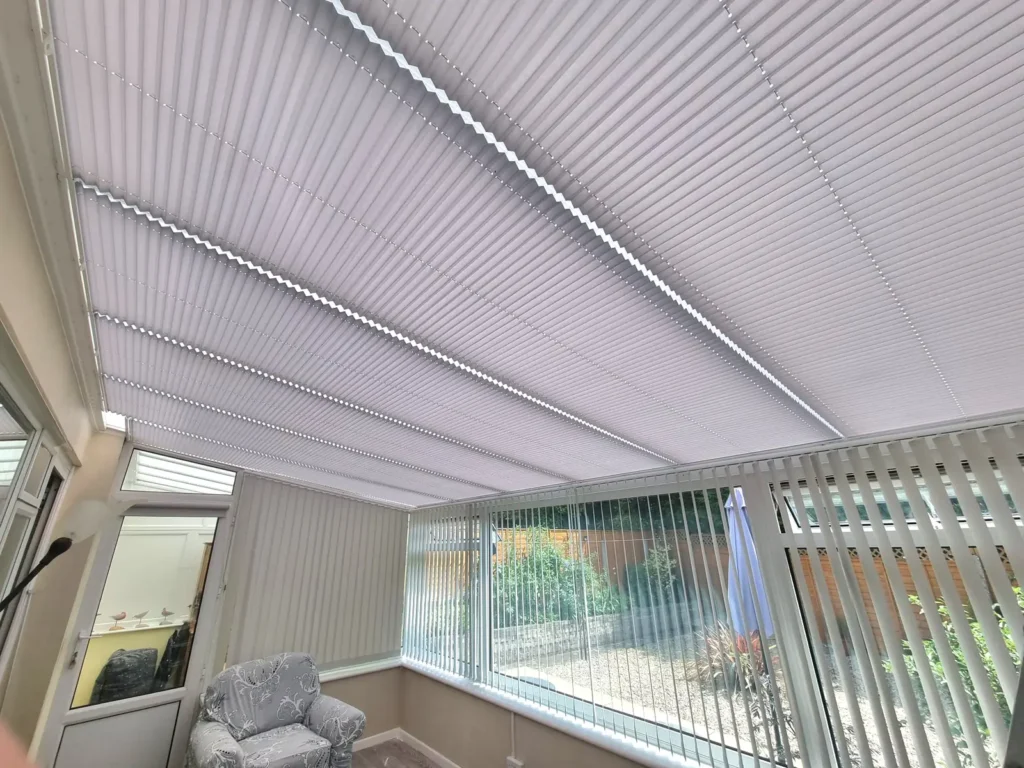
Cellular blinds on roof panels cut summer solar gain and winter heat loss, the most effective single upgrade for an uncomfortable conservatory. Motorisation is recommended above comfortable reach.
Pleated or Perfect Fit pleated blinds (see Perfect Fit page) for side glazing. Perfect Fit clips directly into uPVC beading with no drilling; standard pleated blinds suit timber or aluminium frames.
Pleated blinds sit within the door recess and stack slim, clear of the opening mechanism. A mid-rail option gives privacy at eye height while keeping the view above.
Pleated fabrics can be cut and tensioned to fit fixed triangular, trapezoidal, and arched shapes where a standard blind cannot follow the frame.
Pleated blinds with tensioned side cables fitted to fixed rooflights in kitchen extensions and garden rooms. Works in the same way as a Velux tensioned blind but for non-opening fixed skylights.
Cellular blinds on single-glazed Victorian and Edwardian sashes tackle the heat loss and draughts that make these rooms cold in winter, without the intrusion of secondary glazing.
Both pleated and cellular blinds are available in a range of fabrics designed for specific performance needs. The choice is narrower than for roller blinds – these are purposeful products rather than decorative ones – but within the range there’s enough variety to suit most rooms.
Diffuses incoming light without eliminating it. The most widely used option in living spaces, conservatories, and any room where some natural light is wanted alongside privacy.
Available in pleated and cellular constructions for bedrooms and nurseries. The tensioned fitting system is particularly effective at preventing light bleed around the edges.
Reflects solar radiation outward rather than absorbing it. The strongest thermal performance fabric available for summer overheating – the standard specification for south-facing conservatory roofs in the Bristol summer.
Allows a view through the fabric while softening direct light. Used in conservatories and garden rooms where preserving the connection to the outside is important alongside some glare control.
Many of our pleated and cellular blinds are available in a top-down / bottom-up configuration, which means the blind can be lowered from the top, raised from the bottom, or positioned anywhere in between. In a conservatory side panel or a ground-floor room facing the garden, this lets you keep the upper section open for sky views while the lower section is closed for privacy – without a separate blind for each purpose.
Control options include standard side-cord operation, wand control for doors, and full motorisation for roof panels and conservatory blinds above comfortable reach. For conservatory roof installations in particular, motorisation isn’t optional – it’s the only practical way to operate a blind you can’t easily reach by hand, and the addition of a rain sensor that automatically closes the blinds if it starts raining overnight is a sensible precaution for any conservatory roof installation.
The process is straightforward and entirely managed by our own team.
1
We come to you, bring the sample range, take precise measurements of every window you are considering, and talk through fabric, finish, and control options. No charge, no obligation.
2
You receive a clear, itemised quote. The price is fixed, with no hidden extras at installation.
3
Once you confirm, your blinds go into production. Blinds are typically manufactured and ready to fit within two to three weeks of order confirmation.
4
Our own fitting team installs everything cleanly and carefully, and clears up afterwards. We give you a realistic time estimate in advance rather than a vague window.
5
If anything needs adjusting once you have lived with it for a few days, call us. We come back and sort it.
Independent tests show that cellular honeycomb blinds reduce heat loss through a window by between 30% and 46%, depending on cell depth, fabric specification, and how well the blind seals to the window frame. The benefit is most pronounced on single-glazed or poorly insulated windows – exactly the kind found in Bristol’s older housing stock and in conservatories. In a double-glazed conservatory that still loses significant heat through its roof panels, cellular blinds on those panels make a real difference to winter comfort and heating costs.
Yes – this is one of the most common applications for both pleated and cellular blinds. Roof panel blinds are fitted with tensioned side wires that hold the fabric flat against the glass at any angle, using the same principle as a Velux roof window blind. For conservatory roofs, cellular fabric is the better thermal choice; pleated fabric is appropriate where a slimmer stack or a wider fabric range is wanted. Motorisation is strongly recommended for any roof panel blind – operating a roof blind by cord from a ladder is neither practical nor safe as a day-to-day solution.
Not unless you choose a blackout fabric. Cellular blinds are available in translucent, light-filtering, and blackout fabrics. A light-filtering cellular blind diffuses incoming light rather than blocking it – the room will be softer and more comfortable, but not dark. Blackout cellular blinds are available for bedrooms and are highly effective given the tight edge seal of a tensioned system. The default for most conservatories and living spaces is light-filtering or translucent.
The pleated fabric construction traps less dust than a horizontal Venetian slat but more than a smooth roller blind. Regular light vacuuming with a soft brush attachment is the most effective ongoing maintenance. Spot cleaning with a barely damp cloth and mild detergent works for minor marks. Avoid soaking the fabric – the pleating relies on stiffened material that loses its structure if saturated. For cellular blinds with an enclosed honeycomb construction, the same approach applies; the cells themselves are not accessible for internal cleaning, but the outer fabric surface behaves like any other pleated blind.
Yes. Motorisation is available on most pleated and cellular blind systems and is particularly worthwhile for conservatory roof panels, fixed skylights above head height, and any installation where physical access to the control cord is inconvenient. Motorised systems use a quiet 12V or 24V motor integrated into the headrail, operated by remote control, wall switch, or smart home integration. Rain sensors for automatic closing are also available, which we’d always recommend for a conservatory roof blind that might otherwise be left open overnight.
A pleated blind is a single layer of fabric folded into tight pleats. A cellular, or honeycomb, blind bonds two or three layers together to form enclosed air pockets, which is what gives it its thermal performance. Choose cellular where heat loss or overheating is the problem, and pleated where a slim fit on a door or roof panel matters most.
If a room in your house is unusable for part of the year, that is the room to talk to us about first.