
Europa Blinds supplies and fits made to measure Venetian blinds across Bristol, in aluminium, real wood, and faux wood. Every blind is measured in your home and fitted by our own team.

Made to measure Venetian blinds
No other blind gives you the same degree of moment-to-moment control over light and privacy as a Venetian. Tilt the slats one way and you direct natural light up towards the ceiling for a soft, diffused effect. Tilt them the other and you angle the light down into the room. Close them completely and the room is yours. Raise the whole blind and the window is entirely clear. It’s a level of flexibility that fabric blinds, however good, simply can’t replicate.
Venetian blinds have been around long enough that they can feel like a default rather than a deliberate choice. But a well-chosen, properly fitted Venetian – the right material, the right slat width, the right finish for the room – is a genuinely considered window treatment. The key word is ‘right’. Aluminium in a bathroom makes sense. Real wood in a bathroom does not. Getting the material matched to the environment is the most important decision in the process, and it’s one we’ll walk you through during the home visit.
We supply made-to-measure Venetian blinds to the millimetre, cut and fitted by our own team across Bristol and the South West. Each blind is built on quality headrail hardware and fitted with the appropriate control system for the window and room.
The three Venetian blind materials we supply each have a distinct character and a distinct set of appropriate environments. Here’s how they compare.
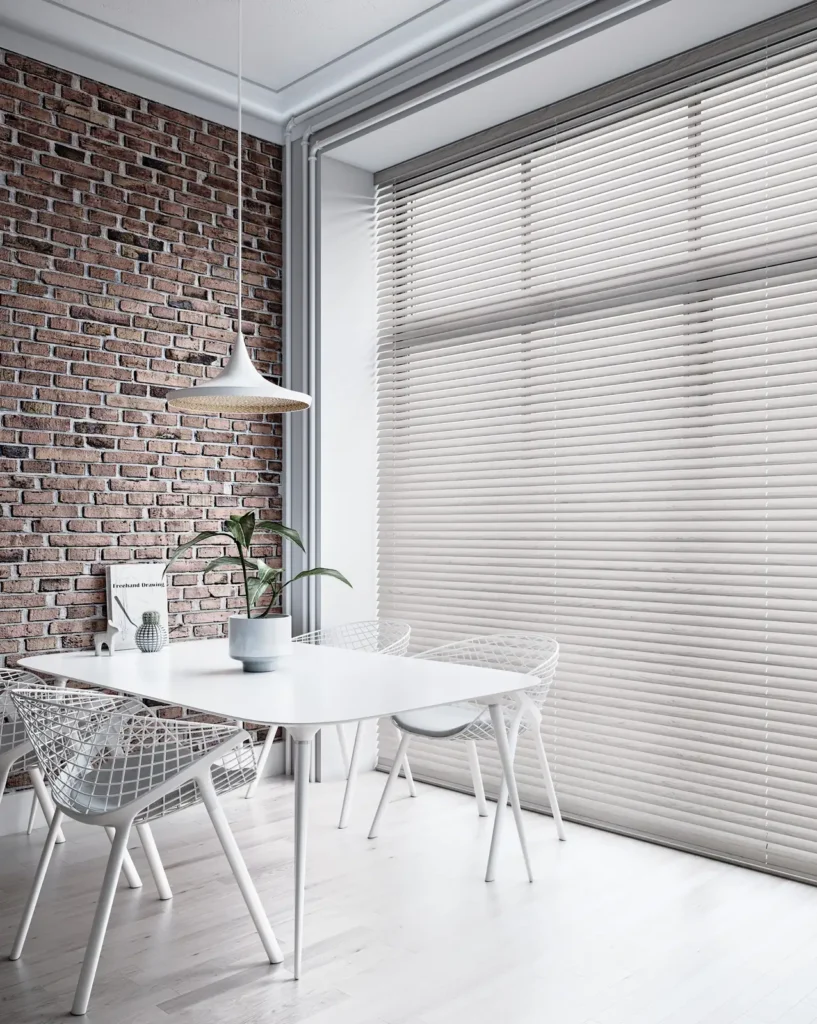
Typical range: £30 to £100 per window (supply and fit)
Best for: Kitchens, bathrooms, utility rooms, home offices, commercial spaces, and anywhere that needs a practical, wipe-clean blind with a slim profile
Avoid in: Rooms where warmth and texture matter more than practicality – a real wood blind will always look more considered in a living room or bedroom

Typical range: £50 to £200+ per window (supply and fit)
Best for: Living rooms, dining rooms, master bedrooms, home offices, and studies – any dry room where the natural grain and warmth of timber complements the interior
Avoid in: Bathrooms, kitchens, and humid environments where moisture will eventually cause the slats to bow, crack, or lose their lacquer finish

Typical range: £20 to £80+ per window (supply and fit)
Best for: Bathrooms, kitchens, conservatories, children’s rooms, and rental properties – anywhere that needs the visual warmth of a wood finish with full moisture resistance and easy cleaning
Avoid in: Very large windows where the PVC slats may sag slightly under their own weight over time – aluminium is a better choice for wide spans
The aesthetic details of a Venetian blind matter more than they might seem. A narrow 25mm aluminium slat in a small kitchen window and a wide 50mm real wood slat in a double-height living room are very different propositions – both in how they look and in how the light behaves when the slats are adjusted.
Aluminium Venetians usually come in 25mm slats; real wood and faux wood in 25mm, 35mm, or 50mm. Wider slats suit larger windows and contemporary rooms; narrower slats sit better in compact windows and traditional interiors.
Powder-coated aluminium in whites, greys, and bolder tones. Real wood in natural stains, lacquers, and painted finishes. Faux wood in whites, creams, and convincing wood effects. We bring samples so you can compare against your own finishes.
Fabric tape ladders replace the standard cords with a woven textile band. They look more refined, conceal the tilt holes in the slats, and improve privacy when the blind is closed. Match the slat finish or pick a deliberate contrast.
A pelmet conceals the headrail housing for a cleaner, built-in look. In period properties with detailed window surrounds, a matching pelmet makes a made-to-measure Venetian look original to the room.
Every quote starts with a free home visit. We bring the samples to you and measure every window, at no charge.
Different rooms make different demands on a window treatment. Here’s what we typically recommend for the most common scenarios we encounter across Bristol and the South West.
Aluminium or faux wood. Both wipe clean and cope with splashes and condensation. Aluminium in 25mm looks sleek and modern; faux wood adds warmth in a traditional kitchen.
Aluminium or faux wood only. Real wood warps in a steamy bathroom. White aluminium in 25mm is the practical default; wood-effect faux wood adds character without the moisture risk.
Any material suits a dry office. Real wood in a warm stain looks settled in a period Bristol study. Aluminium is better where screen glare means adjusting the slats all day.
Real wood or faux wood, for warmth and texture. A wider 35mm or 50mm slat suits the proportions of a generous Bristol reception room better than 25mm aluminium.
Real wood or faux wood with fabric tape ladders. The tape conceals the cord holes, giving a tighter privacy seal when closed and a more refined finish.
Faux wood or aluminium. Both are durable, easy to clean, and resist the wear that softwood and fabric blinds do not survive in high-turnover lets. For wide commercial windows, Durashade.
Venetian blinds accumulate dust on the horizontal slat surfaces more readily than any other blind type. Regular, light maintenance is far easier than an occasional deep clean – and it keeps the mechanism and cords in better condition over time.
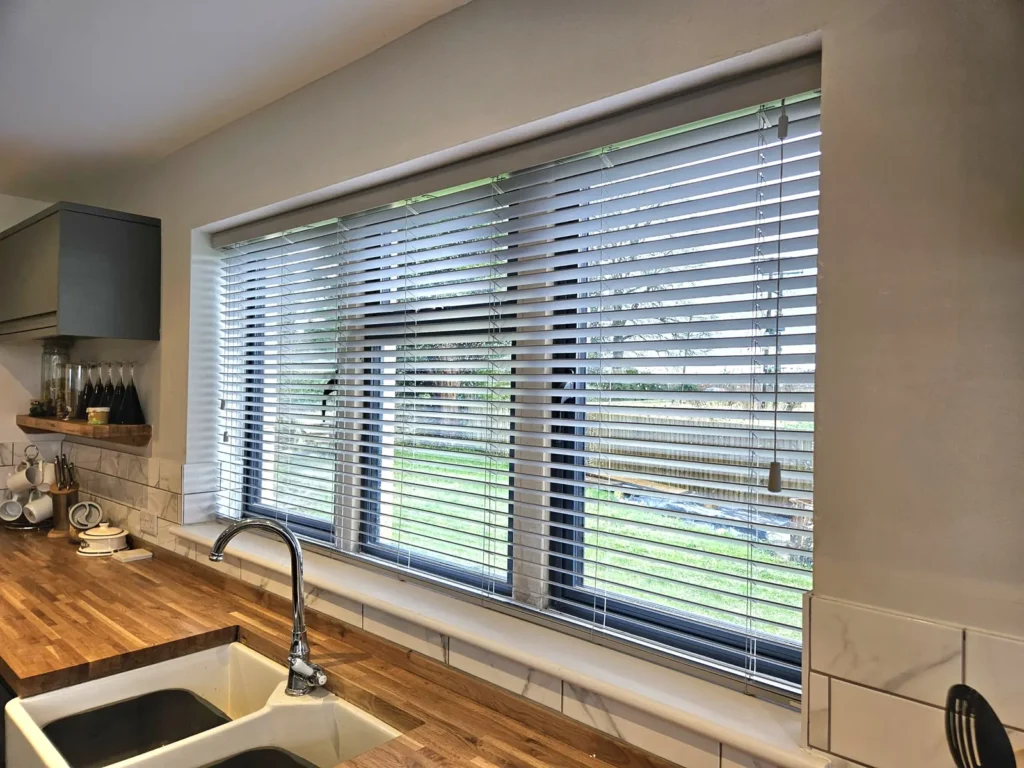
The process is straightforward and entirely managed by our own team.
1
We come to you, bring the sample range, take precise measurements of every window you are considering, and talk through fabric, finish, and control options. No charge, no obligation.
2
You receive a clear, itemised quote. The price is fixed, with no hidden extras at installation.
3
Once you confirm, your blinds go into production. Blinds are typically manufactured and ready to fit within two to three weeks of order confirmation.
4
Our own fitting team installs everything cleanly and carefully, and clears up afterwards. We give you a realistic time estimate in advance rather than a vague window.
5
If anything needs adjusting once you have lived with it for a few days, call us. We come back and sort it.
Real wood Venetian blinds are made from basswood or similar timbers, stained or lacquered to show the natural grain. They have a warmth and authenticity that PVC can’t fully replicate, and they’re the better-looking choice in living rooms, bedrooms, and studies. The trade-off is moisture sensitivity: real wood slats will warp and crack if used in bathrooms, kitchens, or conservatories. Faux wood blinds use PVC-composite slats that look convincingly like timber from a normal viewing distance but are completely waterproof. They’re the practical solution wherever moisture is present. Both are available in a wide range of finishes and slat widths.
Yes – aluminium is one of the two recommended materials for bathrooms, alongside faux wood PVC. Aluminium slats don’t absorb moisture, don’t warp, and wipe clean easily. The powder-coated finish is resistant to condensation and humidity. The main consideration in a bathroom is the control mechanism: keep cords and chains away from direct water contact where possible, and check that the headrail housing won’t be regularly saturated. We’ll advise on the best mounting position during the home visit.
The most effective ongoing maintenance is regular dusting with a microfibre cloth or soft vacuum brush before dust becomes ingrained. Tilt the slats flat to clean them efficiently, working from centre to edge. For deeper cleaning, aluminium and faux wood slats can be wiped with a damp cloth and mild detergent, or removed and soaked. Real wood slats should only be wiped with a barely damp cloth – never soaked – and dried immediately. Avoid harsh chemicals on any Venetian material.
Yes, and in most cases this is the preferred installation for a clean, built-in look. Recess fitting requires the blind to be measured to the internal width of the recess (with a small deduction for operating clearance) and the drop measured to the internal sill or floor. Face fixing – mounting the blind on the wall or window board above the recess – is the alternative for windows where the recess depth isn’t sufficient to house the headrail, or where a wider blind is preferred to cover the full window surround. We’ll assess which approach is better for each window during the home visit.
With the slats fully closed and tilted, Venetian blinds provide reasonable privacy – better than a sheer fabric blind, not as complete as a blackout roller. The small gaps where cord or string ladders pass through the slats allow some light and silhouette to show through, which is why fabric tape ladders are worth considering for bedrooms and street-facing rooms: the tape partially fills those gaps, improving both privacy and the aesthetic finish. For a room where complete night-time privacy is critical, a blackout Roman or roller is a more reliable solution.
Aluminium Venetians are most commonly available in 25mm slats. Real wood and faux wood slats are typically available in 25mm, 35mm, and 50mm widths. The right width depends on the scale of the window, the style of the room, and personal preference – wider slats suit larger windows and more contemporary spaces, narrower slats work better in compact windows and traditional interiors. We’ll show you samples in different widths during the home visit so you can see the difference in context.
As a guide, faux wood Venetian blinds typically cost £20 to £80 or more per window, aluminium £30 to £100, and real wood £50 to £200 or more, supplied and fitted. The free home visit ends with a fixed, itemised quote, with no hidden extras at installation.
Venetian blinds are typically made and ready to fit within two to three weeks of order confirmation. Our own fitting team installs them, and we give you a realistic time estimate in advance.
Colour, grain, and slat width all read differently at home than they do in a showroom. We bring the samples to you.