
Europa Blinds supplies and fits made to measure Roman blinds across Bristol, with standard, thermal, or blackout linings. You choose the fabric at home, from sample books we bring to you.
Made to measure Roman blinds
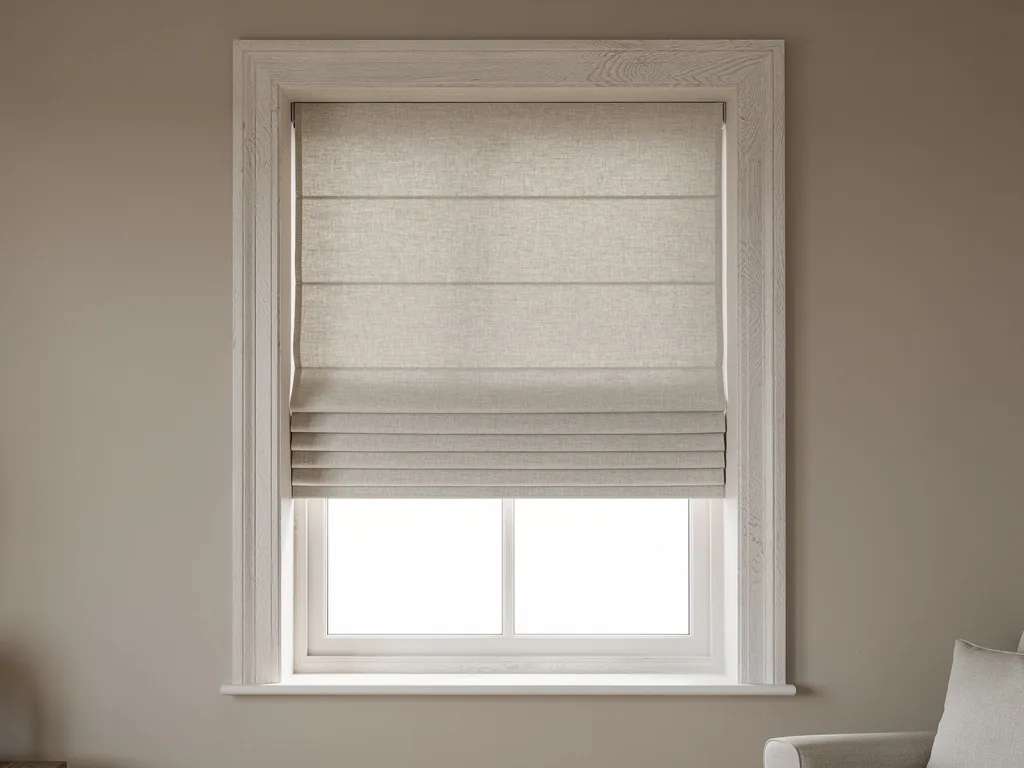
Roman blinds occupy a particular space in the world of window treatments – neither the clean minimalism of a roller nor the full drama of curtains, but something that sits comfortably between the two. When a Roman blind is lowered, the fabric falls in neat horizontal folds that have a visual weight and softness that no hard-edged blind can match. When it’s raised, those same folds stack neatly at the top of the window, keeping the reveal clear without disappearing entirely.
That quality – present when down, well-behaved when up – is what makes Roman blinds the natural choice for rooms where the window is a design feature as much as a functional one. Bristol’s period properties, with their tall ceilings and generous window proportions, suit a Roman blind very well. The structure echoes the architectural detail of the room. A high-quality linen or woven cotton in a period living room feels like it belongs there in a way that a roller or Venetian, however well-made, rarely does.
They’re also considerably more practical than curtains in smaller or awkward rooms – no stack-back eating into the wall, no rings and poles to fit above an architrave that doesn’t have the space for them. A well-mounted Roman gives you the warmth and texture of fabric with the spatial efficiency of a blind.
The fabric is where the character of a Roman blind lives. We supply an extensive range of face fabrics for our made-to-measure Romans, from plain linens and woven cottons through to silks, satins, florals, geometric prints, and bold patterns. The choice is genuinely wide – and it’s one where seeing the fabric in your own room, in your own light, makes a significant difference to getting it right.
The default for most rooms. Gives the face fabric a clean, structured drape, protects it from UV fading, and adds modest privacy and insulation.
Insulating fleece bonded to the cotton lining, creating a real thermal barrier between glass and room. Particularly effective on Bristol’s older sash and casement windows.
A dense, opaque interlining that stops virtually all light through the fabric. The right choice for bedrooms and nurseries; pair with side channels to close the edge gaps.
Soft wadding between face fabric and lining that adds weight, depth, and a luxurious drape. Specified for formal rooms where the look at full drop is the priority.
The lining is equally important, though less visible. It determines how the blind performs thermally, acoustically, and in terms of light control, as well as adding structure and longevity to the face fabric. Here’s how the main options compare.
Roman blinds work on their own, but they also layer well with other window treatments. A few combinations we see working particularly well across Bristol homes:
A sheer voile fixed inside the window recess, with a Roman blind mounted above on the face of the window frame, gives you full privacy and blackout when the Roman is down, soft diffused light when it’s raised with the voile in place, and a completely clear view when both are open. Popular in first-floor bedrooms and sitting rooms facing onto a busy pavement.
Some of Bristol’s most elegant period rooms combine café-style shutters on the lower half of the window with a Roman blind above – the shutters handle permanent privacy at street level, the blind adds warmth and pattern to the upper section of the window. The two textures (painted wood louvres and fabric folds) work well together in traditionally furnished rooms.
In a neutrally decorated room – painted walls, plain furniture – a Roman blind in a bold print or a rich solid colour becomes the focal point of the space. Botanical prints, geometric weaves, and textured plains all work well in this role. We can bring a broad selection of fabric samples to your home so you can audition options in the actual room before committing.

Every quote starts with a free home visit. We bring the samples to you and measure every window, at no charge.
Roman blinds are one of the more forgiving window treatments when it comes to unusual shapes – but they still need accurate measurement to hang and fold correctly. A Roman blind that’s even a centimetre too wide will bind against the window reveal when lowered and cause the fabric to wrinkle along one edge. One that’s cut too narrow will show a gap against the frame and let light bleed in from the side.
In Bristol’s Victorian bay windows, the standard approach is to fit one blind per panel, each measured individually to the exact width of its recess. This is almost always the right answer: attempting to span a bay with a single wide Roman creates a blind that folds awkwardly across the angles between panels. Three separate Romans, each perfectly proportioned for its panel, look considered and intentional.
We also measure for Roman blinds in alcoves, inside deep reveals, and on windows with non-standard proportions. The fabric stack – the folds when the blind is raised – needs to clear the glazing completely to maximise the light opening, which means the stack depth has to be factored into the drop measurement from the start. This is a detail that matters more with Romans than with any other blind type, and it’s one of the reasons professional measuring makes a real difference to the finished result.
If you’re choosing a Roman blind with a prominent repeat pattern, the positioning of the pattern at the fold lines and at the hemline matters. We account for this during fabric planning and cutting, so the pattern sits correctly when the blind is both raised and lowered. This is something DIY ordering services rarely accommodate.

Well-made Roman blinds, from quality fabric with proper lining and a sound mechanism, will last well over a decade with straightforward maintenance. The key is to avoid the things that damage them quickly.
The process is straightforward and entirely managed by our own team.
1
We come to you, bring the sample range, take precise measurements of every window you are considering, and talk through fabric, finish, and control options. No charge, no obligation.
2
You receive a clear, itemised quote. The price is fixed, with no hidden extras at installation.
3
Once you confirm, your blinds go into production. Blinds are typically manufactured and ready to fit within two to three weeks of order confirmation.
4
Our own fitting team installs everything cleanly and carefully, and clears up afterwards. We give you a realistic time estimate in advance rather than a vague window.
5
If anything needs adjusting once you have lived with it for a few days, call us. We come back and sort it.
Yes, and they’re a popular choice for both – particularly when blackout lining is specified. A blackout-lined Roman in a bedroom or nursery gives you a soft, considered look during the day and genuine darkness at night. For nurseries and children’s rooms, we fit child-safe breakaway mechanisms as standard: the chain system is designed to release under tension to eliminate the strangulation risk associated with looped cords. We’d also recommend considering a cordless spring operation for maximum simplicity and safety in children’s spaces.
Yes. Blackout lining is one of our standard options and is available on any Roman blind in the range. It prevents virtually all light transmission through the fabric itself. It’s worth knowing that even a blackout-lined Roman will allow some light to enter around the edges of the blind unless it’s fitted with a blackout cassette or side channels – we’ll discuss this during the home visit and recommend the right approach depending on how critical total darkness is for your room.
The standard approach for bay windows is one blind per panel, each measured individually to the exact dimensions of its recess. Attempting to fit a single Roman across multiple bay panels creates problems with the fabric folding at the angles between panels. Individual blinds, each perfectly proportioned for its section, look much cleaner. We measure every panel separately as part of the free home visit, so there’s no guesswork involved.
Regular vacuuming with a soft brush keeps them in good condition with minimal effort. Spot cleaning works well for minor marks. The main thing to avoid is machine washing – lining adhesives and batten tape don’t survive it. For a deep clean, professional dry cleaning is the right approach. Roman blinds are not the choice for very humid environments like steamy bathrooms or commercial kitchens.
A well-made Roman blind, from quality fabric with proper lining and good mechanical components, should last 10 to 15 years with reasonable care – and often considerably longer. The face fabric will typically be the first thing to show its age, particularly in a sunny aspect without UV protection. The Louvolite chain and ring system we use is built for long-term domestic use, and the breakaway safety fittings are replaceable if needed. Quality at the point of manufacture is the biggest determinant of lifespan.
This is one of the real advantages of the free home visit. We bring a broad selection of fabric samples to your home so you can compare colours, textures, and patterns against your existing walls, flooring, and furniture in your actual light – not in a showroom under strip lighting. If you have a specific colour reference (a paint code, a cushion fabric, a tile sample), bring it out when we visit and we’ll work from it. For prominent repeat patterns, we also account for pattern placement at the fold lines and hemline during cutting, so the finished blind looks considered rather than accidental.
Usually two to three weeks from order confirmation. We measure every window at the free home visit, including the depth of the folds when the blind is raised, and our own team fits the finished blinds.
Fabric reads differently against your walls and in your light. We bring the sample books to you, at no charge.